Monday, December 23, 2013

The Best Christmas Pageant Ever by Duke City Repertory Theatre

Passion for the arts comes in every size, and for many young artists, it strikes at an early age. For those who wish to hit the stage as fast as they can, stories such as "The Best Christmas Pageant Ever," produced by Duke City Repertory Company and playing at the Cell Theatre, provide an opportunity for the artist and audience alike.

Photo credit Rick Galli
In a time when schools are de-emphasizing the arts, and slashing budgets as well, stage opportunities for young actors are met with enthusiasm by myself. So often, children's roles are diminished and one-dimensional in plays. What's most refreshing about this show, beyond its holiday appeal, is the chance for young actors to show their chops in roles that require not just line and blocking memorization, but comic timing, physical humor, and even character development. As Grace Bradley declares, "Jesus, Mary, even the short kids; everyone's important!"


Photo by Rick Galli
Lauren Myers plays Mother/Grace Bradley, the one who must direct this year's church Christmas pageant after a series of mishaps beyond her control, such as Mrs. Armstrong landing herself in traction. Equally beyond control are those "awful Herdman kids," the delinquent bunch who show up to church for the first time ever once they find out from young Charlie Bradley (Elijah Ortiz y Pino) that refreshments are being served there.

Cigar-smoking ringleader Imogene Herdman, played quite believably by Lillie Raine Kolich, bullies her way into being Mother Mary, and the rest of her siblings inevitably follow suit to join the cast as well. The heart of the show comes from watching the heathen Herdmans react to being a part of the Christmas story, having now heard it for the first time ever. Imogene has perhaps some of the best lines in the show, not only in her over-the-top pussy willow scene, but more so in pageant rehearsals, "My God! They didn't have room for baby Jesus?"  

Photo by Rick Galli
Surprisingly, each Herdman brings something unique to the pageant's production. Young Gladys (Ruby Webb-Sagarin) augments her part as the angel of the Lord by adding directions so the wise men wouldn't get lost. Leroy (Joaquin Madrid Larranaga) brings baby Jesus a welfare ham as his wise man's gift. Ralph (Matthew Joel Barkley) plays Joseph and Imogene garners laughs while indelicately burping baby Jesus in the way a true mother would. Perhaps it was me, but I could see Imogene having an authentic moment, likely being the one who rocked her own brothers and sisters, taking care of them in the absence of any true parental care.
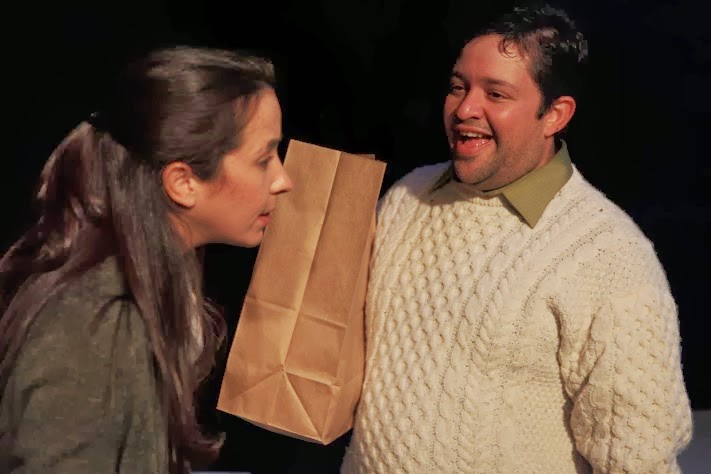
Photo by Rick Galli
For the purpose of the show, the six Herdmans from the original book are reduced to four, which works nicely for the intimate playing space of the Cell Theatre. The show has many supporting parts, such as Grace's husband (Ezra Colon) but the bulk of the storytelling is done by young Beth Bradley, who often acts as the narrator in the show. Playing for a tight 45 minutes, this is no easy task and Mackenzie Jarell excels at the challenge, reminding us grownups what it's like to be caught between the peer and bully dynamics and the expectations of your parents & elders.

Directed by Katie Becker Colon, the show has all of the heart of original book by Barbara Robinson, and is a story I remember from when I was young myself, so it gave me a sense of nostalgia to come back to this story and hear it fresh once more. I admit, I am a softy through and through, and when Lillie, as Imogene playing Mother Mary, sang "Silent Night," I got a bit teary. Sure to touch your heart, the actors of this show are destined to give you a sense of Christmas cheer and remind you of what the season truly means to so many.

For more information about the Duke City Repertory Theatre's 2013-14 season, as well as their burgeoning outreach programs for children, visit their website at www.dukecityrep.com. 

Thursday, December 19, 2013

Miracle on 34th Street at Albuquerque Little Theatre

A Christmas classic, "Miracle on 34th Street," is a seasonal treat for audiences at the Albuquerque Little Theatre. Adapted from the novel by Valentine Davies, this story has been playing on our television sets as the 1947 film version for years, but seeing it live has a different pace, and keeps the show new, while maintaining the familiar for the nostalgic ones in the audience.


John DuBois plays Kris Kringle, the man who believes he's Santa Claus. Witnessing a drunken Santa interacting with kids at the Macy's parade, Kris steps in and insists he should play Santa since he is Santa. Diane Villegas brings the skeptical Doris Walker to life, a female executive at Macy's, and a single mother in a time when divorced single mothers didn't exist in normal society. Suspicious of Kris, her opinions are torn between those of the psychologists and counselors, and those she loves who believe in Kris, such as her daughter Susan (played adorably by Elise Klinger in the role movie buffs recall belonged to young Natalie Wood). But it is Kris whom Susan confides in, wishing for "a father, and a house" for Christmas.


Doris' jaded heart is the object of Fred Gayley's affection, played by Nick Fleming, who seeks to woo Doris without scaring her off. Fred insists Doris is afraid, but she argues it's common sense, not fear, that anchors her beliefs. As the debate grows over whether Kris is the real Santa or not, the issue is settled in court, much the same as the classic film version's tale. When Judge Harper (Hugh Witemeyer) is presented with irrefutable evidence, the verdict we all hoped for is given.

The underlying message of the play is the exploration of faith, "believing in something when common sense tells you not to," and for Doris, she must learn to believe in love and second chances, as much as she does in Kris Kringle. Giving the show some comic counterpoint is Dehron Foster's role as the psychologist Leslie Sawyer, tipping the levity with laughter in his moments onstage. A perfect choice for a show to introduce young kids to theater, with many children onstage to watch as well, the play is heart warming and full of the messages of the holiday season.

Directed by Henry Avery, the story flows nicely in and out of interiors and exteriors thanks to the set design, and kudos to the construction crew not only for some sharp looking sets, but most especially for the wow factor of the Macy's parade float.

To catch this seasonal classic, head to Albuquerque Little Theatre, located near Old Town, or visit their website at www.albuquerquelittletheatre.org to purchase tickets, find out showtimes, and much more about the rest of their 2013-14 season.


Thursday, December 12, 2013

Up (The Man in the Flying Chair) by Mother Road Theatre Company

December theatre options are usually seasonal fares -- Nutcrackers and plays about Santa, or Scrooge -- but for those wanting something a little different for their theatre experience, "Up (The Man in the Flying Chair)" provides it. Currently playing at the Musical Theatre Southwest Center for the Arts, this is not the Disney-fied "Up," with a lovable curmudgeon. This is a lot grittier.

Set in 1989, the dialogue between the Griffins is modernly authentic and, along with the dynamic of the family, it draws you into their tale. Perhaps director Vic Browder knew it would feel like two hours of eavesdropping, because the cast as a whole seem exquisitely aware of how easy it would be to over-act these roles and so they are slightly underplayed, and more believable as a result. In an intimate space such as the MTS Black Box, even a whiff of melodrama would spoil this play's impact. Father and wannabe inventor Walter Griffin, played by Shangreaux Lagrave, is the frustrated dreamer, full of big ideas yet unable to make anything of his ambitions to help him succeed. Amy Suman plays Walter's wife, Helen, who is frustrated beyond measure with her husband's inability to take responsibility and provide for their family, choking on her own buried rage at times, yet she never stops loving her husband.


Their 15 year old son Mikey, played by Grey Blanco, is caught in the middle, supportive of his father's dreams but also old enough to see his mother's dissatisfaction, and wonder why his father can't do better for himself. When Mikey hooks up with pregnant teenager Maria, played by Amy Bourque, his own coming-of-age tale begins to unfold, while his father's life simultaneously begins to dramatically unravel.

Lagrave's performance as Walter has a touch of Willie Lomax to it, that sense of time slipping away and opportunities that never return, haunting and baffling the central character. Lagrave knows how to oscillate between Walter's bombastic moments, as well as his deflated ones. Commendable in her ability to sustain the rage and intensity of Helen, Suman finds the balance between haranguing and desperation. Bouncing between them, Blanco shows us Mikey's adolescent need to find his own destiny, and make his own way. When he begins to outperform his father, you sense that Mikey has lost the childhood hero that his father once was to him.

The metaphor of being "up," suspended in the sky by floating chair or high wire, calls to Walter after the one event in his life that gave him a sense of purpose and destiny -- the day when he tied weather balloons to a lawn chair to soar to a height of nearly 16,000 feet. The rest of his life is consumed with the "job" of inventing a flying chair, the Paramotor, although every new attempt seems a miserable failure. When Walter sees a picture of tightrope walker Philippe Petit, he exclaims, "There's a man who's living his dreams!" And when describing having a job to his son, Walter equates it to being "tied down," and "picking up someone else's shit."

The dream-like scenes where Petit appears to Walter are perhaps some of my favorite moments in this show. Lit in a hallucinatory purple light, actor Ron Weisberg takes his tightrope walks while philosophically talking to Walter about the meaning of life, and later, we see Mikey on the high wire with Petit, symbolically living his own teenage dreams, even though convoluted and not fully formed. These moments evolve the play from an ordinary family drama (a la Neil Simon but with more dysfunction and less humor) and into something more magical and otherworldly.


Perhaps the most inscrutable character in the show is Maria herself. Caught in the circumstances of her dysfunctional family life with her aunt (Staci Robbins) as certainly as Mikey is caught within his, Maria's emotions vacillate between a street smart fast talker, and a vulnerable, unwed mother-to-be. Bourque sells the drama pitch perfect, allowing the audience to decide by the end if Maria is a willing perpetrator of Mikey's downfall. ("Downfall," a show like this makes one realize how often "up" and "down" are deeply ingrained human metaphors).

If this premise seems quasi-biographical, it is. Although more recent lawn chair launches have been attempted, the most famous is Larry Walters', Lawn Chair Larry, the inspiration behind this Bridget Carpenter play, who launched himself via lawn chair and weather balloons in California in 1982. Also unable to find his way in this world, the real life Walters died some years later by his own hand.

For more about the show, and their upcoming 2014 season, visit the Mother Road Theatre Company website at www.motherroad.org.

Sunday, December 8, 2013

Man of La Mancha by Landmark Musicals

The beautiful mind of the mad man is Landmark Musicals' focus in "Man of La Mancha," the final show of their 2013 season. The show's layers of story telling are slowly revealed to the audience, allowing us to see the illusionary Don Quixote through the eyes of his alter ego, Alonso Quijana, as told by Miguel de Cervantes, who is thrown in prison, along with his manservant, for foreclosing upon a castle and awaits questioning by the Inquisition.

Described as "either the wisest mad man, or the maddest wise man," when Jack Nuzum embodies Don Quixote's persona, he is swept away by his own grandiose delusions, convincing all around him to either humor him and play along, or to scoff at his madness. Nuzum's ability to sink into each layer of his character, from Don Cervantes to Don Quixote is found in the shaping of his words and the carriage of his body, simply becoming each one alternatively. A strong tenor, his voice lives up to the challenge of Quixote and delivers the sound that longtime fans hope to hear.


Consistent in his care, despite his master's madness, is the jocose Sancho Panza, who explains away every eccentricity by remarking, "Knights have a language of their own." Played by Vernon Reza, he acts more as caretaker to his master's delusions, finding the nurturing side of this character, who could become sarcastic or sardonic in the hands of the wrong actor. Instead, Reza allows the audience to identify with Don Quixote by acting as that voice of love and reason to the visions of greatness he cannot see, but pretends to.

Cast by Don Quixote as Dulcinea, the ultimate female to whom every quest is dedicated, is local tavern wench Aldonza, whose attitude toward men and love has long since gone sour, as we see in, "It's All the Same." Tasha Waters finds Aldonza's jaded heart easily, but alternatively softens to Don Quixote's delusions, and regrets her own bitter reality. Abused grievously, she represents the harsh reality that Don Quixote's romantic notions cannot begin to fathom. Waters' operatic training shines through in the role, giving her Aldonza a larger than life quality that elevates her to the level which Quixote sees in her. 
Giving counterpoint to the show was Bryan Daniels, as the Duke and Carrasco, showing Albuquerque yet again that he is becoming known for his character voices. Exceptional at keeping an accent while never losing focus in the moment, Daniels gives some menace to the production, perhaps even more so than the figure of the Inquisition itself, the Captain.

Landmark Musicals' producer Myra Cochnar describes the company's goals of bringing high production values and live music to each show, and director Paul Ford uses the home of Rodey Theatre to the musical's ultimate advantage by sinking the musicians into the orchestra pit, and allowing the pit itself to become an alternative entrance, integrated at times into the story itself. It's been done before, but it never ceases to delight me, I admit. 

The sound of this show was far more operatic than a traditional musical might demand, and music director Wojciech Milewski aptly blends the Spanish elements of this score into the vocals as well. With a strong ensemble cast, the sound was full and as epic as the bombastic quests of the mad man himself; songs such as "We're Only Thinking of Him," and "Little Bird, Little Bird," showing off their "mad harmonic skills." And as proof there are no small roles, only small actors, was my favorite muleteer, Alex Wasson. His gently authentic expressions as Sancho's mule -- at times an extension of his own master's emotions, much the same as Panza extends the emotions of his own master, Quixote -- were so precious, they kept me smiling continually in this show.

For more information about their upcoming 2014 Landmark at the Rodey Season, visit their website at www.landmarkmusicals.org or give them a call at (505) 453-8844. 

Thursday, November 28, 2013

SPOTLIGHT: Guillermo Figueroa, Artistic Director of the Figueroa Music & Art Project

There are many tales of reinvention in theatre, and Guillermo Figueroa's approach to his artistic career has centered around taking chances and embracing the changes that a career in the arts can encompass. Raised in a family of music lovers, the violin was placed in his hands at the age of  five, and the instrument became the catalyst to his lifelong pursuit and love of music.

As a third generation musician in his family, Figueroa's musical studies began with his father and uncle at the Conservatory of Music of Puerto Rico and continued later at Julliard, here in the United States. A renowned violinist, he went on to perform with the Orpheus Chamber Orchestra in New York City, and many more companies as a guest musician. Figueroa was concertmaster of the New York City Ballet for a decade, performing with the ballet company, and even collaborated with ballet master Peter Martins to have a piece made with him onstage, playing the violin, alongside a piano, and two dancers performing.

His inspirational approach to music has brought forth more than dance pieces, but four concertos with orchestra written for him, which Figueroa performed the world premieres of, and many smaller works which have been composed for him also. After playing a Berlioz opera in Carnegie Hall, Figueroa became fanatical for the composer's work, confessing he absorbs as much of Berlioz's music as possible in his off hours, and even went so far as to organize a Berlioz Festival, commemorating the 2003 bicentennial of the birth of the composer here in Albuquerque, featuring lecturers, poets, painters and, of course, musicians, to commemorate the event.


His work as a conductor and guest conductor have allowed him to collaborate with some amazing artists, such as Itzhak Perlman, YoYo Ma, and Placido Domingo, to name only a few. Collaborating with Ernesto Cordero once again, Figueroa recorded Cordero's concertos for the Naxos label, earning him a Latin Grammy nomination in 2012. When asked how these profound experiences affect his own art, Figueroa insists that by finding ways to combine artists and their various artistic expressions, whether by graphic arts, music, or dance, the audience benefits the most.

Never one to slow down, Figueroa worked as the music director of the Puerto Rico Symphony while also acting as the conductor and music director at our own New Mexico Symphony Orchestra, starting in 2002. When the Symphony folded, Figueroa couldn't see letting the momentum go here in New Mexico, and so began the Figueroa Music and Arts Project. Created with the vision of combining music with other art forms, (a forte of his) and bringing excellence in performance quality and artistic focus, the Figueroa Project collaborates regularly with other New Mexico artists and companies to bring performances of the highest caliber for audiences to enjoy.

Click above to watch Guillermo Figueroa perform Insula, written for him by Ernesto Cordero

His Diaghilev-like approach has encouraged many in our New Mexico arts community to collaborate and with such masterful combinations onstage, the audience is the true winner. It was just such a collaboration that first brought him here in 2000, when Patricia Dickinson Wells, currently the artistic director of Festival Ballet Albuquerque, asked Figueroa to conduct "The Nutcracker," setting off the chain of events which culminated in his offer to become music director at the New Mexico Symphony.

Figueroa and Dickinson Wells never stopped their artistic collaboration, with one concert recently concluded ("The Firebird and Tchaikovsky") and another gala event to come. "New Years Eve in Vienna," modeled after the well known Vienna Philharmonic concert broadcasts, feature a lighter fare of music as well as some Hungarian dance pieces, giving the audience their own taste of Vienna. Featuring the dancers of Festival Ballet Albuquerque, the event takes place on December 31st at the National Hispanic Cultural Center at 8 pm. For a additional price, those wishing to make an evening of the concert are invited to stay afterward for the catered reception to raise a glass.

Looking towards the rest of the 2013-14 season, Figueroa is excited about even more unique combinations of art forms that are in the works. In February, collaborating with the St. Johns Church in downtown Albuquerque, as well as the chorus of St. Johns, an all Baroque program will be presented. And in April, the Figueroa Project will perform a chamber-oriented program, "German masters and the Holocaust, a Theatrical Remembrance." Featuring music of Schubert and Mozart for the first half of the program, the second half will be Marc Neikrug's "Through Roses," featuring the actor John Rubinstein (son of acclaimed pianist Arthur Rubinstein) alongside the music, during a reminiscence of a holocaust camp.

Knowing resources should be shared, and fostering collaborative efforts among the companies in order to achieve a new and higher expression of art, is what makes Figueroa such a uniquely talented musician and artist. For tickets to the gala, their future concerts, and more information about Guillermo Figueroa and the Figueroa Music and Arts Project, check out their website at www.figueroaproject.org.

Thursday, November 21, 2013

Spring Awakening by UNM Dept Theatre & Dance

"Spring Awakening" is one of those musicals with a cult-like following, audience members ask each other, "Is this your first "Spring"?" Well, this was my first "Spring," and with a controversial reputation preceding it, I had high expectations of this first experience without knowing exactly what it would be like. And, like so many firsts, it was beautiful, scary, ugly and tender all at once, thanks to the pool of talent currently producing work at the University of New Mexico's Theatre and Dance department.

Photo by Pat Berrett
Set in a provincial German town in 1891, it may at first seem difficult to understand why this musical is so massively popular, especially with younger performers and audiences. But with universal themes of rebellion, insecurity, curiosity, burgeoning love, rejection and questioning faith comes the answer; it's a story about being young and yearning to know everything while still searching for your own identity. The tragedy of this tale, we find, does not lie with the youths who question so much of their world's faith, its gender roles and, most particularly, its unwillingness to discuss sexuality. The tragedy is the unwillingness of the leaders, parental, scholastic and spiritual alike, to speak the truth to their youth and empower them to make enlightened decisions.


Photo by Pat Berrett
Stafford Douglas plays Melchior, the forward thinking rebel who's cocky, yet yearning for love. Wendla, the inquisitive young woman who plays opposite Melchior, is tender-hearted, although conflicted between the expectations others have of her. Dramatically, Andee Schray finds Wendla's varying emotions, and has an exquisite voice to bring to the role, with inflections that reminded me of Sarah Mclachlan at times, both haunting and beautiful. Douglas tells the arch of Melchior's tale by showing us the emotional transformation that circumstances put him through, finding the distinction between Melchior's arrogance and, later, his humility. Knowing that love and heartache in their world are inevitably intertwined, their chemistry-filled duet's lyrics remind us, "You're gonna be wounded / You're gonna be my wound / I'm gonna bruise you / You're going to be my bruise."

Photo by Pat Berrett
Around these two lovers we meet others who give voice to their own repression. In Moritz, Cory Meehan gives a touchingly honest approach to the parental rejection and perceived failure he believes himself to be. Never giving in to the pathos, Meehan makes acting choices, such a tender smile in some of the most humiliating of moments onstage, that give his character frightening depth and realism. Equally moving was "The Dark I Know Well," primarily Martha's song, played by Alexandra Uranga, in her embarrassing long sleeves and overly tight braid (examples of how the costuming extends each character's story, as seen through designer Erik Flores' eyes). There is an emotional void you see in children who have lived through grievous parental abuse, and Uranga finds this atmosphere without once slipping into something maudlin. Quite simply, the moment moved me to tears.

Photo by Pat Berrett
With a score whose sound is part modern, with electric guitar and bass, and part antiquated, with violin and viola, the music underscores the parallels between a repressive time long gone by, and the restrictions we continue to face today. As a tale that is quickly reaching modern audiences, director Kathleen Clawson cast this ensemble tightly, and they function together neatly within the whole of the story. Never to be overlooked, the show featured live music, complementing the cast's strong vocals, led by music director Paul Roth, weaving their vocal talents with the strings' melodies and creating this musical's unique and often haunting sound.

For more about the UNM Theatre & Dance Department, their performances at Rodey Hall and other venues, you can visit their website at theatre.unm.edu , or call their office at 505-277-4332.


Thursday, November 14, 2013

Boeing Boeing at the Aux Dog Theatre

Gather round, children, while Alissa tells you a tale of what air travel used to be. There were no TSA agents and you kept your shoes on, because flying was a glamorous activity and the stewardesses whose job it was to keep you comfortable while in the air were the sex symbols of their time. Synonymous with feminine appeal, a single stewardess was considered a coup for a man, so imagine having three? Boeing Boeing, a comedy of errors currently playing at the Aux Dog Theatre, gives us a glimpse into one man's fantasy life, setting this precarious situation comedy up so we can watch things as they inevitably fall apart. With each fiancee from a different country, working for a different airline and always in motion, Bernard believes he really can have it all (with a little extra help from his maid, Berthe), as long as his life runs as smoothly as the aviation time tables that he relies upon.

But of course, it's a French farce so the three fiancees converge upon their mutual Paris flat, disrupting the coordinated life of Bernard, played by Brennan Foster, and making room for his friend Robert to observe, and later interact with, Bernard's female complications. Foster's comic presence is often understated, and more believable because of the restraint, lending the broader strokes in this slapstick comedy an understated sense of credulity.

Directed by Victoria Liberatori, Aux Dog's Artistic Director, the giggles turn into guffaws as we witness Bernard struggle to manage the women in his life, but equally interesting are the individual personas of his fiancees. Gloria, his American fiancee working for TWA, is played by Sheridan Johnson as the bubbly personality whose enthusiasm for Bernard, her lover in France, is as exotic to her tastes as the flavors of the foods she eats.


Gabriella, the Air Italia stewardess played by Merritt Glover, is luscious and temperamental, and ultimately the one who compels Bernard the most. Finding a balance between her vocal inflections and her physicality, Glover gives us plenty of sauce to Gabriella's gravy.

His third fiancee is Gretchen (played by Jessica Osbourne), from Germany's Air Lufthansa, who is conflicted between her love for Bernard and her burgeoning attraction for his friend Robert, played by Matt Pruett. Fearless in her approach to Gretchen's conflicted decisions and her extreme, German emotionalism, Osbourne finds a variety of emotional levels and dimensions to her character, making the twists of her character's fate more believable as well.

The only woman Bernard isn't sleeping with (that we know of) is Berthe, his "domestic servant," played by Angela Littleton. Well aware of her employer's shenanigans, Littleton's Berthe is the reluctant accomplice with an arsenal of verbal barbs that she handles as gracefully as she does his antics. As Bernard's friend Robert, Pruett brings out his character's transformation, taking him from a wide eyed, Wisconsin innocent into a more worldly and sophisticated man, such as his continental friend, all while learning how to manage the expectations of a woman. Pruett's facial expressions and comic delivery are reminiscent of Jim Carrey at times, with a commitment to the physical humor that requires a touch of inner daredevil.

If you're ready for your boarding pass, book your trip by getting tickets at their website www.auxdog.com or by calling their box office at 505.254.7716 and climb aboard their flight full of frivolous fun.